In my recent effort to put myself more “out there” in the online world, I have tried to do so with intention. Which platforms work for me? How much time will my mental health allow? What sort of public “persona” do I want to present? The whole process has felt a bit silly, especially considering I haven’t officially published anything yet. But, these things don’t happen overnight and I’d rather have made the decisions when I had the time to process them. Sort of like the old D.A.R.E. program: if you decide early not to do drugs, you don’t have to decide later.
To be honest, I think we all could have benefitted from setting up those boundaries before venturing into the world of social media. What is my purpose for doing this? What sort of persona do I want to present when I interact? How will I react to negativity? Something to ponder.
One of the things that I deleted was my Goodreads account. Though I saved all of my book reviews for my personal use, I had to really think about how I wanted my voice to be used online.

The purpose of criticism
I can often get stuck on definitions of words and don’t always take the time to consider their broader (or multiple) meaning(s). I was walking around a bookstore with a friend who wanted to visit the literary criticism section and I bristled at the phrase. Images of an English teacher’s red pen flashed through my brain, alongside the hundreds of negative comments that so often permeate even the greatest works of literature. After a brief (but kind) chastising, I was reminded that true literary criticisms come from well-educated and well-read individuals who will often highlight the good in a piece rather than shouting at the world how much they hated it.
For context: literary criticism – the formal study and discussion of works of literature, for example by judging and explaining their importance and meaning
For good and for bad, we live in a day when everyone has the freedom to share their opinions. For good? Everyone can be heard. For bad? Everyone can be heard. 😉 This puts more power and responsibility in our hands to decide who we should listen to.
Whether it’s a couple of friends or worldwide connections, Goodreads is a wonderful place to find communities. There are people I’ve never met that I will follow because of the reviews I have read of theirs and I find that, more often than not, they recommend things I like. In a world filled with millions of books, a good recommendation is worth its weight in gold-leafed books.
Words matter

After writing and editing (and re-editing) a 120,000 word novel, I learned very quickly that every word that I wrote mattered. Because if it didn’t, why write it at all? This is not a high school paper that I am trying to fill by shrinking the margins and increasing the font size. Purpose matters. I am accountable to myself for every word and defending their right to be on the page.
If I’m doing that for a work of fiction, shouldn’t I extend myself the same dignity and courtesy of my words that represent myself online?
I have a limited amount of energy and what stock I do have I want to make sure is put to the best use I can. Promoting and defending my work? Absolutely. If I’m willing to share it, I’ll stand by it. But, when it comes to other people’s work I realized something that calmed my almost always anxious soul:
It’s not my responsibility to share my opinion.
I don’t have to be a defender of anything if I don’t want to. Because, sharing an opinion online is like chumming shark infested waters.
That gives me such a feeling of power and control (the good kind) over the things I do want to invest my energy into. The world needs to hear about the good things and if there are those who disagree, it’s much easier to stand by something you love (and be honest about it).
As a fairly easy-going teacher, the times when I “got serious” were far more powerful because it was such a rarity. So, when I recommend something publicly, that should be a sign that it’s worth at least checking out.
The Power of ‘Not for Me’
The true empowerment comes from not wasting your time on the things that don’t resonate with you. I’ll admit, I have spent hours angrily sifting through 1 star reviews of authors who wasted the hours I spent reading something I absolutely hated. Phone calls made, book clubs ruined, banners hoisted in protest, all in the name of feeling vindicated in my beliefs that those who loved it were wrong.
But what came from it?
Embarrassingly, I’d argue I spent more time analyzing my loathing of a “bad” book than ruminating on the good ones.
That’s not a place I want to live.
It’s not a mindset that’s going to make me a better person and especially not a better writer. Imagine if professionals based all their learning on bad examples rather than studying good ones: bakers eating charred cakes, architects walking among ruins of collapsed buildings, and doctors prodding dead bodies. Yes, there are lessons we can learn from failures but only when the majority of our time is spent studying the best examples to emulate.
So, now when I read something I don’t enjoy, I stop, take a breath, and say:
“Not for me.”
Full stop.
I don’t need to call anyone, jump online to read scathing reviews, or post my own. My energy can be better used to find the next thing that is for me. If people ask me what I thought of books, “Not for me,” is such an easy response that doesn’t require much else. If someone read my book and I asked them about it and they said this, I would be glad to know they didn’t feel obligated to like it because they know me. Of course, if you know the person, it’s always nice to include things you did like (I’ve never read a book that was 100% bad) but end it with the same words. “I really liked this character but, in the end, the story was not for me.”
Done. Relationship still in tact. Move on and find the people that the story is for.
Words worth remembering
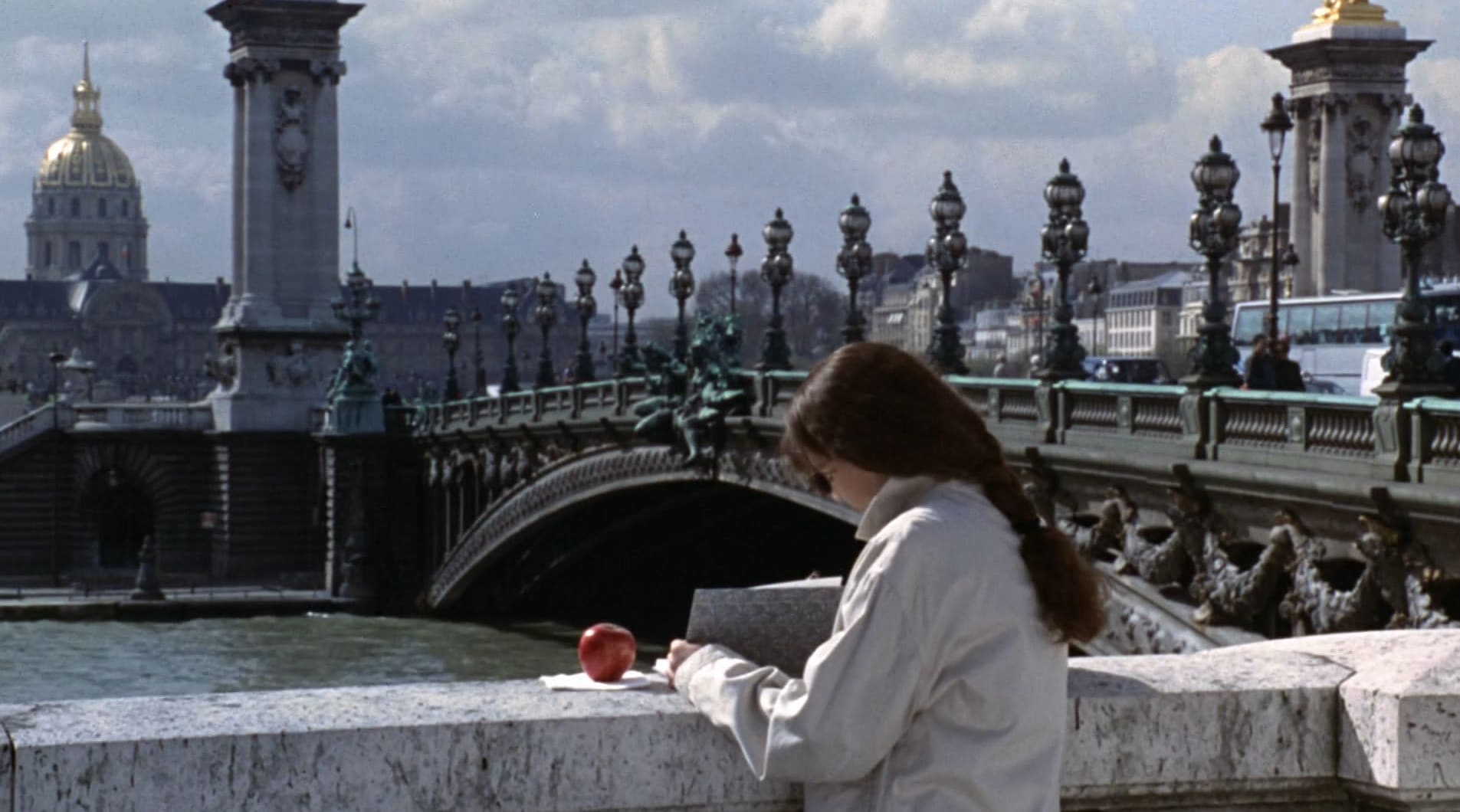
In a sea of streaming services with new releases happening weekly, it’s easy to forget the classics that came before. Take a trip with me back to the 90s. This was back in a time when movie releases weren’t as regular so when they did come out, most people saw the same ones. While I appreciate more voices getting to share their stories, I think we miss out on the community that was created over the shared movie experience.
So, in an effort to preserve such gems, I want to share my favorites each week. This one comes from the endlessly quotable Sabrina. Proof that Harrison Ford is so much more than an action star.
“I sat in a cafe, I drank coffee, and I wrote nonsense in a journal. And then, somehow, it was not nonsense. I went for long walks… and I met myself in Paris.”
Your words matter, even if they’re “just” for you.
Writing Inspiration
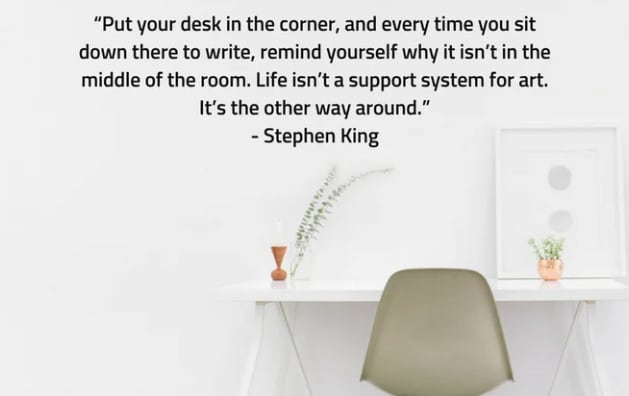
And, to close, some words of inspiration. While I am not a fan of horror, or have read much of his work to be honest, I really appreciate what Stephen King has to share about writing. He’s a man who knows his craft and I appreciate that he’s so willing to share that advice with others. It’s almost enough to forgive him for creating Pennywise who’s haunted my dreams since I was seven….almost.